

by Mark Hills, CEO of Molok North America and a leader in the Canadian Waste Industry for 25 years
So, after more than two decades working inside waste and recycling systems, I’ve come to an uncomfortable conclusion: We’ve normalized a system that doesn’t work—and then blamed users for the underwhelmingly poor results.
We see overflowing bins, we see contaminated waste streams, and we see organics diversion efforts that never quite perform as expected. So, what do we do?? We add more signage, and more education and more reminders, and when it still falls short… we point back to behaviour.

Across the country, we see that waste diversion targets are climbing, 50%, 70%, even zero waste! A valiant effort, but on the ground, in the heart of our communities, in cities big and small, the story hasn’t changed much. Contamination remains stubbornly high, Organics programs continue to struggle, and Hauling costs? Still rising.
So, I feel that it’s time to ask the harder question, one we don’t ask often enough: What if the problem isn’t the public… but the system itself?! Across North America, we’ve invested heavily in education, into signage, into enforcement, and into awareness campaigns. We’ve implemented penalties, we have bag tags for garbage, and yet, performance continues to plateau.
Why?! Because while we’ve focused on influencing behaviour, we’ve largely ignored the structural realities shaping it. The truth is this – Waste systems are perfectly designed to deliver the results we’re getting. The legacy of historical collection methods entrenched as they are in the fabric of multi-billion-dollar waste and recycling collection companies does little to illuminate the realities of today’s needs.
I’ll break down four critical gaps quietly that are limiting performance across residential, commercial, institutional and industrial waste segments:
The Behaviour Gap
The Data Gap
The Accountability Gap
The Infrastructure Gap
These aren’t new ideas, but they are underexamined—and often avoided. If we’re serious about improving diversion, reducing contamination, and controlling costs, we need to stop treating symptoms… and start addressing the system itself.
We begin where it all starts: Behaviour.
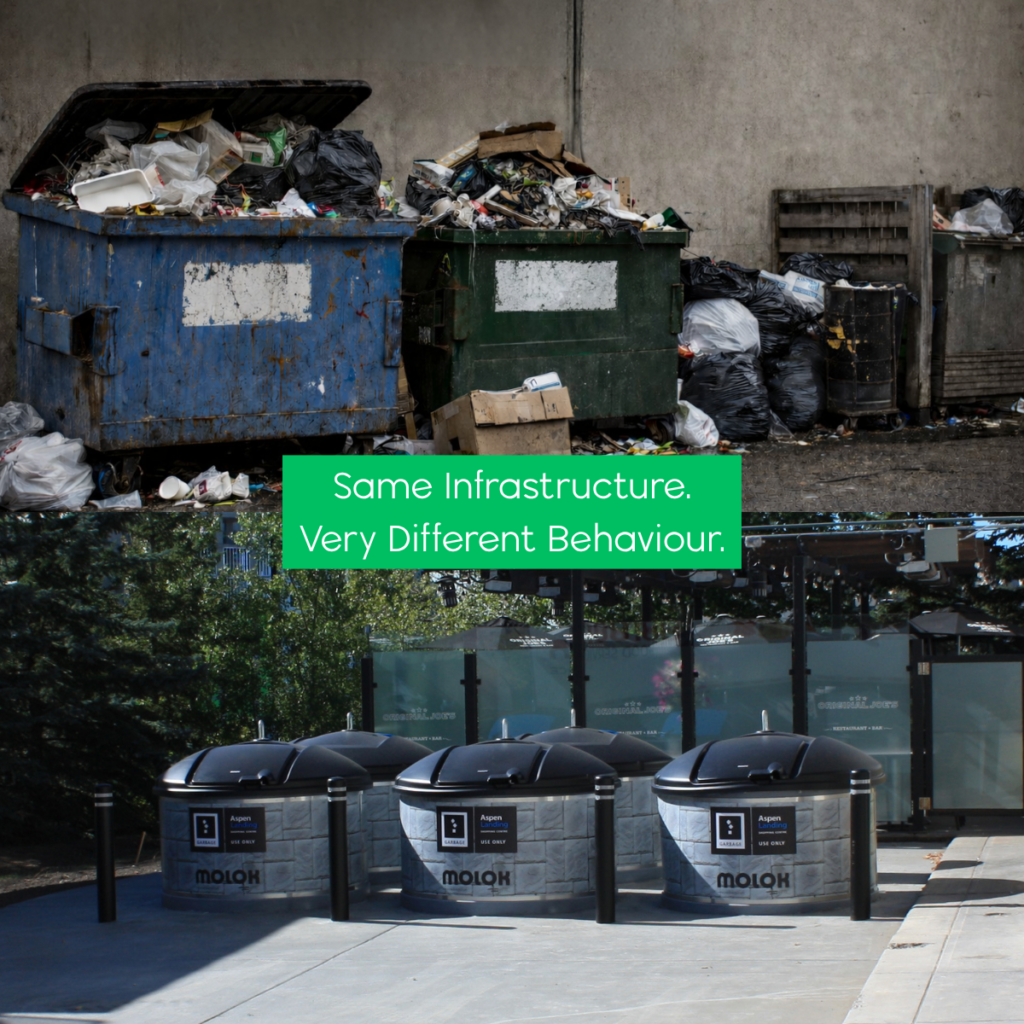
Part 1: The Behaviour Gap in Modern Waste Systems
From my career experience in both the public and the private sector I have found that if you spend enough time inside real-world waste systems, a pattern becomes impossible to ignore:
The issue isn’t capacity – it’s behaviour.
Across residential, commercial, institutional and industrial waste segments the same challenges show up again and again:
- Unauthorized usage
- Cross-stream recycling contamination
- Organics contamination
- Overflow driven by misuse—not actual demand
And, this isn’t isolated. It’s systemic.
Across North America recycling contamination routinely falls between 15–30%. Organics contamination in many regions exceeds 20%. And yet, the response remains largely unchanged, typically focusing on More Education, More Signage and More Messaging.
But here’s the uncomfortable truth: Most shared waste systems are still completely anonymous, with little or no control over use! And there is little to no accountability for how they are used. When responsibility is blurred and subsequently unmeasurable, the lines are blurred and individual accountability disappears.
So, we find ourselves in a strange position as an industry: We know behaviour is driving contamination and diversion failure—yet we continue to manufacture and use legacy systems that can’t see, measure, or respond to behaviour at all.
That’s not a people problem! That’s a design problem!
Expecting better outcomes without changing the system that shapes behaviour is, at best, optimistic… and in its worst form, downright negligent. So, if we’re serious about improving diversion, we need to move beyond awareness—…and start building systems that create accountability by design. We try to educate and build awareness and “Hope” for improvements, but let’s face it if there is no behavioral change, how can we expect a better outcome.
The blind spot quietly limiting performance across North America: The Data Gap.
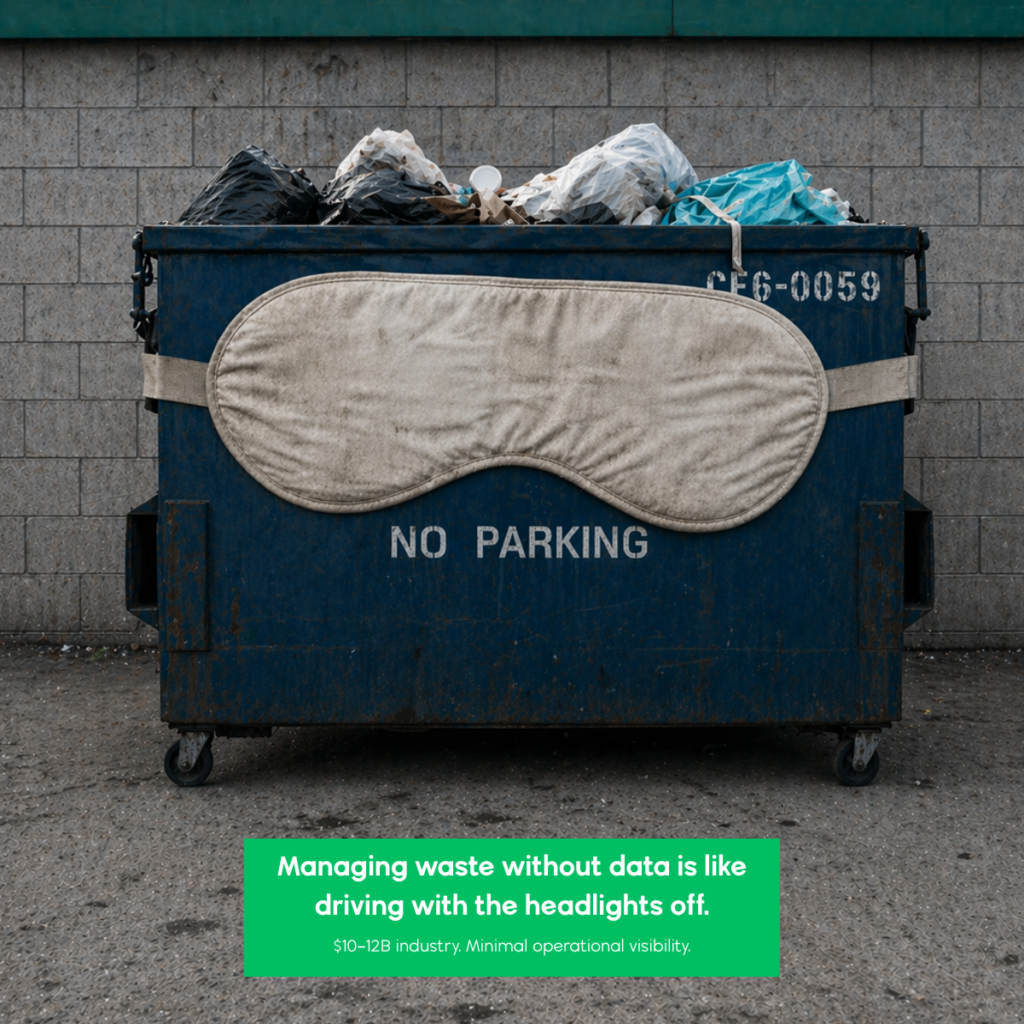
PART 2: The Data Gap in Modern Waste Systems
If behaviour is the first structural challenge in modern waste systems, the second is something even more fundamental. Data.
Despite billions spent annually on waste collection and diversion programs (approx. $50 billion in Canada), most waste infrastructure still operates with surprisingly little operational visibility. The process is simply – Waste Happens – Trucks are Routed – Haulers Arrive – Waste Disappears!
But between those steps lies a blind spot. Property managers rarely know how their waste containers are being used. Hauling schedules are frequently based on perceived needs that fit into fixed routes rather than real conditions and subsequently often lack clear insight into which locations consistently generate contamination.
What’s the result? The system runs largely on routine rather than information. Some containers are emptied when they are only half full, others overflow before the truck returns. Contamination is discovered only after material reaches a processing facility — long after the opportunity to correct behaviour has passed.
In most industries today, that level of operational opacity would be unacceptable. For example, Retail tracks inventory in real time to avoid shortages. Transportation monitors vehicle movement continuously assuring great communications and on-time preparedness. Energy systems analyze consumption patterns down to the minute.
Yet waste management — a sector central to environmental performance and urban sustainability, and costing Canadians an estimated $10–12 billion annually — still operates with surprisingly little operational intelligence.
This isn’t a failure of effort, but without reliable data, even well-run systems struggle to improve. You cannot optimize what you cannot see.
Which raises another uncomfortable question: If diversion targets and ESG reporting expectations continue to rise, why are so many waste systems still operating without the data required to manage them effectively?
Next up: The Accountability Gap.
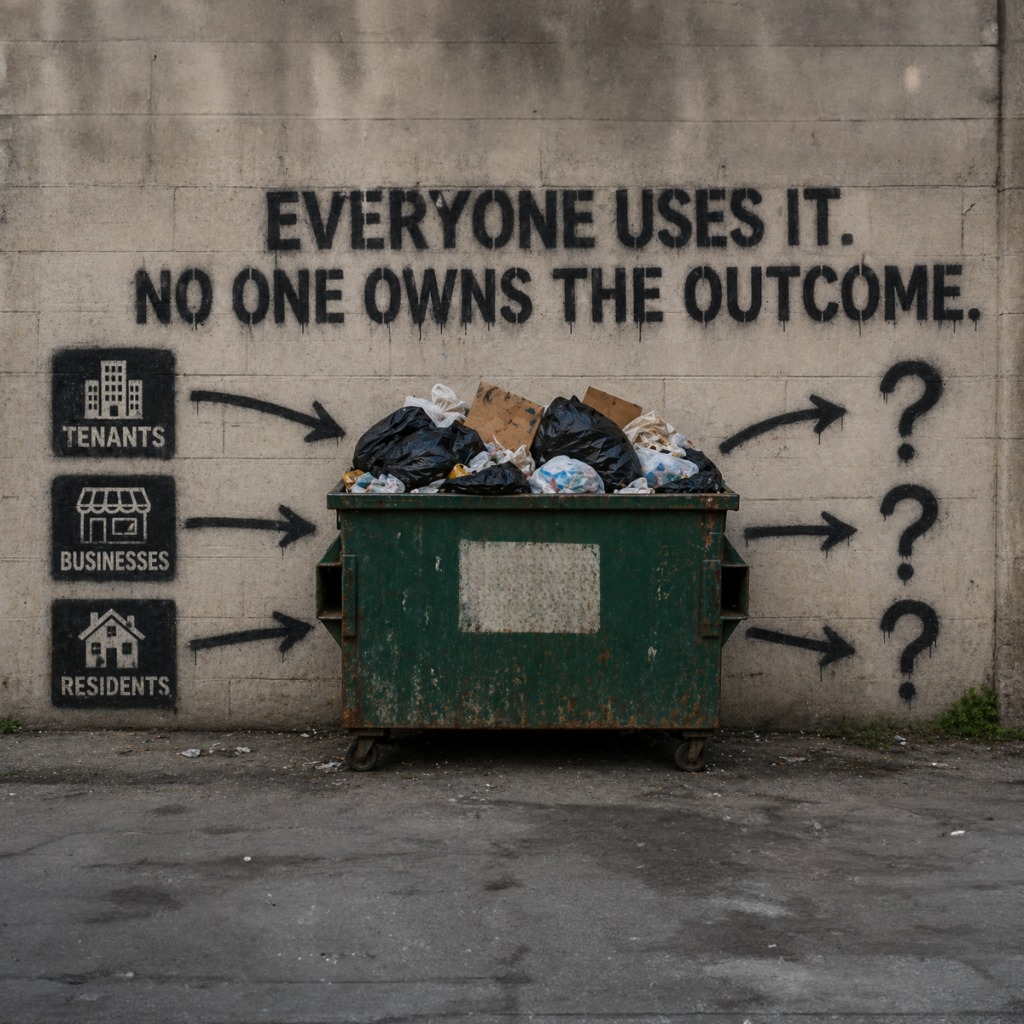
PART 3: The Accountability Gap
In the world of waste and recycling management, Behaviour matters. Data matters. But without Accountability, neither produces meaningful change.
Across most shared waste environments — apartments, campuses, commercial properties — responsibility quickly becomes blurred. Residents blame Neighbours and Property Managers blame Tenants. Municipalities blame contamination and Processors reject loads because of it. In short, Everyone participates in the system but No One takes ownership and owns the outcome.
This is the accountability gap. In other sectors, shared systems function very differently. Utilities measure usage by unit. Parking systems track vehicles. Building access systems log entry by user. Responsibility remains connected to behaviour.
Waste systems rarely work that way. Most operate as open systems. Material goes in and Costs go out and Responsibility disappears somewhere in between.
So, when contamination rises or diversion stalls, the industry responds the same way it always has: Remember this? More Education campaigns, New Signage and only Random and Occasional enforcement. However, none of these measures address the structural reality that accountability is largely invisible inside the system. This leaves municipalities and property managers trying to influence behaviour they cannot actually measure, and that raises the question that sits at the heart of this entire series:
What would waste infrastructure look like if it were designed to close the behaviour, data, and accountability gaps?
PART 4: The Infrastructure Shift
For decades, waste infrastructure has been designed around a simple objective: Contain and remove waste. From a logistics perspective, the system works. But modern expectations have changed. Waste systems are now expected to support diversion targets while reducing contamination, improve operational efficiency, and create environmental transparency through good ESG reporting.
The unfortunate reality is that we are asking 20th-century infrastructure to deliver 21st-century outcomes. This is one of the key explanations why the structural gaps explored in this series continue to persist. Data remains limited, behaviour remains invisible, and accountability essentially disappears.
And the industry continues to rely heavily on education and compliance messaging to compensate for structural weaknesses built directly into the system. It’s not surprising that other sectors have already made the shift. Transportation networks became intelligent, creating efficiency and predictability. Energy systems became smart grids ensuring reliability and confidence. Buildings became connected environments assuring safe and efficient use in a user centric manner.
Waste infrastructure is only beginning to evolve in the same direction. When systems can measure who uses them, how they are used, and when service is actually required, something important begins to change. Usage and behaviour become visible. Data becomes insightful and subsequently actionable. Accountability becomes possible! The system begins to influence outcomes rather than simply react to them.
This leaves one final question for our industry: If smarter infrastructure can close the behaviour, data, and accountability gaps… How long will we continue to build and use systems that were never designed to manage them?
Hint… we have developed a solution!
 EN
EN  FR
FR